 Some plums we found on an urban foraging excursion.
 This year's basil harvest. Pesto, anyone?
 Does anything say summer like corn on the cob?
Watermelon, maybe.
 An uncomplicated love affair
I'm not sure how Heather, the outreach coordinator of our local Co-op, thought to ask me to write an article for the quarterly newsletter. We hardly know each other, yet when she was trying to think of someone who might like to write a feature about eating local, I came to mind. I happily accepted, giving the article an inclusive title, in the hopes that my byline might become a regular feature. I enjoyed writing something for publication, and we also enjoyed the payment: a 20% discount for a week.
If you're a regular reader, you already know most of this stuff about our family. But Jon encouraged me to post it, anyway. So here it is:
Local Solutions
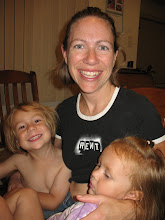
I remember walking through the mainstream grocery store with my 3-year-old son, Zephyr, and 6 month old daughter, Jubilee, a year ago, just after reading Barbara Kingsolver's Animal, Vegetable, Miracle: A Year of Food Life. I was equipped with all the reasons why I should eat only locally grown foods. I dutifully asked the produce worker if there was any local produce, and of course, he answered in the negative. Zephyr asked for broccoli, I told him no, it had been trucked in from too far away. He spotted mangoes, and I sadly refused him again, dying a little bit inside with the knowledge that my new conviction might prevent us from ever tasting their juicy sweetness again. I fretted that Jubilee would suffer the most, since I wouldn't be able to offer much variety to her developing taste buds. As we continued down the aisles, tossing tortillas, and not much else, into the cart, my mood turned dismal. It doesn't make sense, but by the time I walked through the freezer section, I had pretty much lost hope, and gave in when Zephyr asked for frozen waffles. I couldn't explain to my perplexed husband, Jon, why I came home with the waffles, which had to be transported in a refrigerated truck, and had little nutritional value, but not the broccoli.
I look back on that shopping trip with a mixture of feelings. My determination was strong, but as the trip wore on, my empty cart filled me with despair. How would I feed my family?
We wanted to eat more local foods for a variety of reasons. One, our family tries to minimize our consumption of petroleum. Eating tomatoes trucked in from who-knows-where just doesn’t make sense, especially tomatoes that taste like mildly salty mush. Two, as local business owners ourselves, we understand the value of putting money into the hands of our neighbors: other families, like us, doing their best to get by. Three, genetically modified foods grown on huge lots sprayed down with large amounts of poison just don't feel right to us. I could go on, but what it all comes down to is that we love our children, and we want to do right by them, both in personal nutrition choices and economic and environmental sustainability.
So where did we take it from there? Obviously, my all-or-nothing approach was not going to work. Taking into account our lamentably limited access to recycling facilities, we audited our pantry and decided to try home canning enough local apples and tomatoes to last us through the year. During harvest season, we'd come home from the Saturday Farmer's Market with up to 80 pounds of produce. We'd pounce on the project as soon as our kids went down for their nap. Skinning tomatoes, coring apples, and listening for that canning jar "pop" became our companionable quality time activities. The satisfaction of seeing our pantry filled with brightly colored jars of home-canned goods instead of anonymous boxes and bags is enormous. We saved dozens of jars from the landfill, and while we underestimated the amount of applesauce and apple butter we needed, we still have a few jars of spaghetti sauce to keep us until this year's crop arrives in abundance.
There are some things we buy with regularity that aren't local. Local grains are difficult to find. We haven't weaned ourselves of soymilk or organic dairy products. Probably our worst crime is vegetarian "meat" products, which come heavily processed and refrigerated or frozen. We're far from perfect, but when a local option is available, we take it.
Our favorite local eating comes from our backyard garden and greenhouse. In the summer we grow tomatoes, basil, cucumbers, strawberries, many varieties of squash, green beans, heirloom melons (Jon's obsession), onions, garlic, potatoes, peaches, apricots, Asian pears, pecans, and figs. In the winter, our garden provides us with chard, beets, lettuce, peas, broccoli, rapini, Chinese cabbage, and celery. Then there's our regular Saturday morning hang-out, the Farmer's Market. We are lucky to live within easy walking distance from the downtown location, and unless we're out of town, you'll see us there. Something just seems right being able to connect the food around our table with the faces that grew it. We buy Colorado flour from Hannah, tomatoes and cucumbers from Jason, eggs from Renee, asparagus from Nancy, apples and pecans from Monroe, melons from Sherry, and greens from Sandra. We are very grateful to all the farmers who provide such a large portion of our diet from local land.
Are you thinking of going local? During a recent "Eat Local Week" challenge, I found that it helped to develop some flexibility when it came to meal planning. I generally like to plan each grocery trip with a stack of cookbooks and a calendar. During our challenge week, I instead made lists of what was available to us. Proteins included eggs, pecans, pistachios, and peanut butter. (You can also get local meat.) For produce, greens, cucumbers, and asparagus were in season. We had peas and strawberries in the greenhouse. Also, anything I had canned or froze during last year's harvest was legit. Carbs were tricky. I enjoy baking our own bread and sweets, but if you're going to get technical about it, even the basics are impossible to come by locally- things like oil, salt, and yeast. I decided I would bake with my Colorado flour without guilt. Once I had my lists, meal planning involved choosing something from each category. As long as there was a protein, carb, and veggie on the plate, we were eating well.
So, I challenge you to examine your diet, and try to increase the amount of local foods you consume. The Co-op makes it easy to find food from local growers, and the season of bounty is upon us. Local foods actually taste better (because they were allowed to ripen on the plant and picked fresh), have more nutrients (because they haven't been genetically modified for ease of transport), and help your community farmers keep their livelihood. Goals like "I'll eat one local vegetable a day," and "I'll buy all my eggs and pecans locally," are easier to achieve than "I'll eat one local meal a week," because staples like spices and rice can make it seem impossibly hard to pull together an entire local meal. Have a "mostly local" potluck with your friends and feast on your collective creations. Refuse to feel defeated, even when you end up with California broccoli or, heaven forbid, frozen waffles in your cart. Smile, breathe, and remind yourself that we're all doing our best, day by day by day.
 Some plums we found on an urban foraging excursion.
 This year's basil harvest. Pesto, anyone?
 Does anything say summer like corn on the cob?
 An uncomplicated love affair
5 comments:
Well written, Nora (as always). I be they do ask you to write regularly. :)
I concur, well done dahlink! and by the way, have I mentioned how much I adore you lately?
xoxo
I think I could die very happily in your backyard -When can I come visit? :)
I love the balanced approach. Your garden sounds wonderful! I can't wait to start one of my own.
Can you please post a photo of you in braids? It just makes sense that you've been wearing yours like that too. Photos of the garden, please! I love the latest ones of the kids. And yes, the girls would LOVE to share a big bowl of popcorn. When is it again that we get to see eachother? It can't come soon enough.
Post a Comment